Topics inside this course
Awareness and induction depth — not an accredited occupational qualification.
- Assess task, individual, load and environment
- Keep the load close; don’t twist
- Trolleys and two-person lifts
- Office moves and archive boxes
- Report pain early
Built for the people who take the training
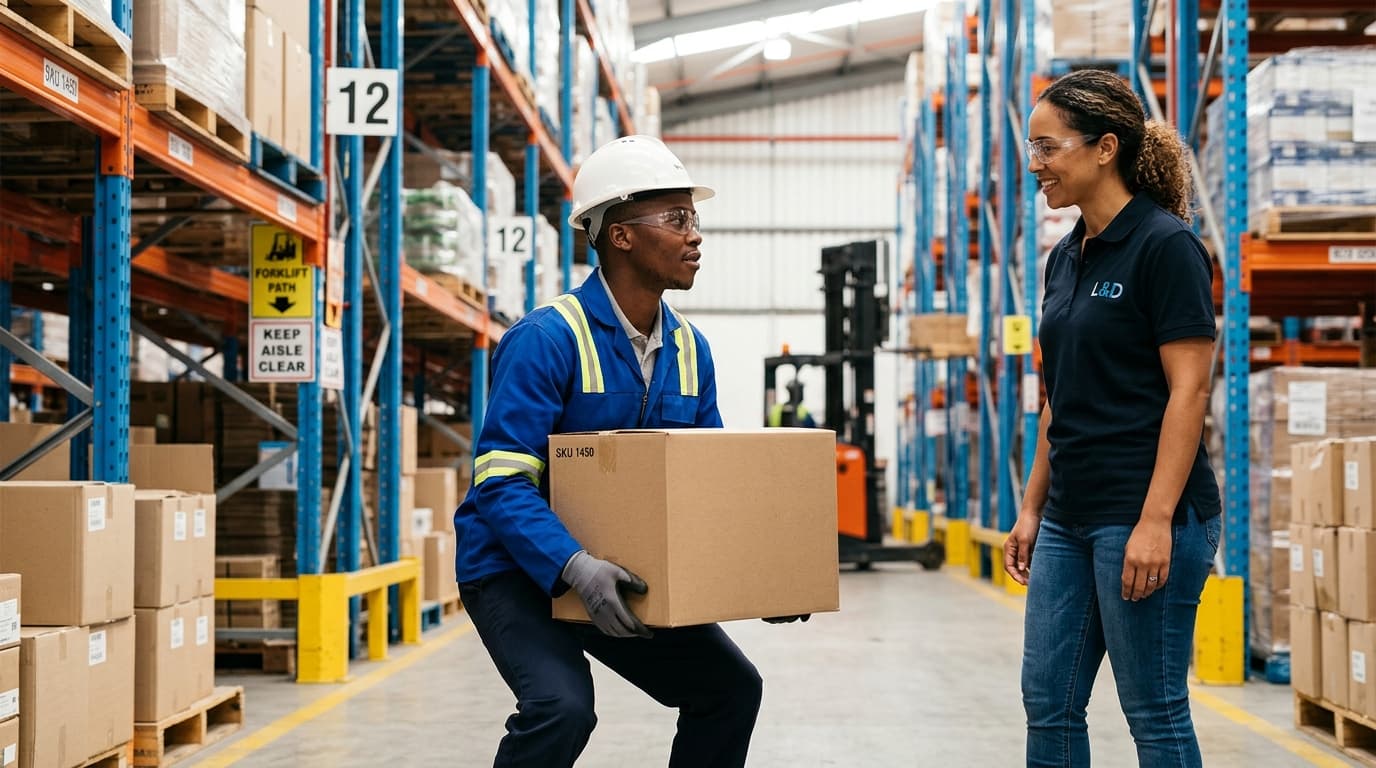
Warehouse, facilities, retail and office staff who lift boxes, water bottles, archive crates or furniture.
What learners leave able to do
- Assess a load before lifting and use mechanical aids where they exist
- Ask for help instead of “just getting it done”
- Report pain early rather than working through it
- Apply the same rules to office moves as to warehouse pallets
Modules you can expect
Structure may tighten when you localise from your own source pack in Kre8AI — this is the shape of the library title.
- 1It counts in the office too
Water bottles and archive boxes.
- 2Assess first
TILE without the essay.
- 3Lift or don’t
Aids, help, split the load.
- 4After it hurts
Report; don’t hero.
- 5Knowledge check
Short scored assessment.
Short scored assessment. Awareness only — not a practical lifting sign-off where your risk assessment requires one.
Written for the workplace, not for the statute book alone
Manual-handling injuries are not only a warehouse story. Office moves and water-cooler bottles produce the same damaged backs. This course is the awareness layer: assess, get help, use the aid, stop when it hurts.
TILE (task, individual, load, environment) is taught as a 20-second habit, not as a risk-assessment template for specialists. Supervisors learn that “we’re short-staffed” is how people lift what they should not.
It does not replace practical training where your risk assessment requires it, and it is not physiotherapy. Generate from HSE guidance, Ergonomics Regulations extracts, and your SOP in Kre8AI so the trolleys and weight limits you actually have are named as placeholders or as fact.
Publish as SCORM or HTML. Pair with fatigue and contractor induction where relevant. Re-export when the SOP changes.
Retail and facilities teams usually assign this at induction. Keep it short enough that people finish it before the next delivery.
Play the library demo, or generate manual-handling awareness from your risk assessments in Kre8AI.
What you would upload in Kre8AI
Manual handling procedure, risk assessments
- HSE manual handling guidance (TILE)
- South African Ergonomics Regulations extracts where relevant
- Your manual-handling SOP and risk assessments
Formats, coach and provenance
- Standalone HTML to play in the browser; SCORM 2004 for your LMS.
- Optional AI course coach on Growth and Scale — grounded in approved material; off on quizzes and final assessment by default. Course plays offline; coach needs a network.
- Built in Kre8AI and reviewed before we published it. Not a substitute for your organisation's own policy — review before you make it mandatory.
Get the SCORM package while you are here.
Same course, SCORM 2004. Load it to settle the tracking question — and keep it as a course your people can take after you review it.
Request the package
SCORM 2004 zip. We ask for an email so we know which LMS you are testing — and so we can send the download.